On two occasions (2007 and 2015) I tried to make note of the current changes or additions in the game of tennis.
NOTE: MORE CHANGE! After rereading the article below (done in 2015) I’d like add a few things. I do think a rereading before reading the “new” comments may help.
Time moves on. What has changed from the 1980’s up until now in the tennis world? Certainly some “physical” improvements have affected rackets. So much power generated with such ease.
There’s more night play. Lights are better, courts are better, and surfaces are improved.
Television continues to “spread the game.” Instruction is better. College coaches are now better paid and better informed.
Prize money, and more scholarships for Americans and internationals, has recruited athletes who now “pick tennis first.” These people are not people who “…couldn’t play anything else.”
And they are bigger, stronger faster. They train, their diets are better, weights are commonly used, etc.
A very positive change in governance of matches. The point penalty system cleaned up behavior problems.
College refereeing is better and they use more refs. Still two people can’t officiate six (or more contests).
Pro players are less likely to drink to excess now. “Rounders” or “tennis bums” have been “weeded out.”
Indoor facilities have leveled the playing field. Now many people, particularly young people, can play even year round, not just in the “weather-blessed” areas. When you don’t stop all year long, your “tennis education” grows expontentially (no re-learning” time needed, or wasted.)
One contrast with football and basketball is related to size. Soon there will be a 400lb, 6’9” football left tackle who is also quick (Read The Blind Side) or a basketball player who can dunk himself. Tennis and golf professionals still haven’t produced a dominating 6’7” superstar. Perhaps height produces more possibility for error in “lengthy shots.” Who knows, but “average sized” people still have a chance in championship tennis. (You do need a “big heart”)
The effectiveness of western grip forehands, like two-handed backhands, has been truly “certified” by numerous players. I would still encourage young players to add (“I didn’t change anything, I gave you a new one” – Jim Verdieck) a back-
hand under spin ball. It is a “tool” worthy of learning this grip change from Western to Continental, needed to hit this valuable shot.
If there were one other obvious suggestion it would be to observe how many forehands are now hit with “open” stances. Many “purists” of my day would straighten up that front lead foot. I think the rackets aid young players here, but the “western gripped – open stance- sling-shot forehand” stands on it’s own feet (one quite “open”).
All players now have access to what the great players of the later twentieth century taught tennis. Here are some examples (in addition to two handed back hands, and open stance forehands):
Bjorn Borg. I think Borg taught the world to “hit is as hard as you can.” And he hit it in! It could be done. Topspin helped! (“I may hit long, I may hit wide, but I won’t hit into the net”)
Pete Sampras: Serve and volley with the same philosophy as Borg’s ground- strokes attitude.
If you hit it as hard as you can you eliminate a lot of judgment errors, based on “how hard to hit when?” (“Grip it and rip it” – John Daly)
Martina Navratilova and Billie Jean King: Women can play the all court game. All things being equal groundstroke – wise, those who can attack also, will win.
There were at least two other contributions that are “must mentions.”
Andre Agassi: Took ground strokes and the value of conditioning to a whole new level late in his career. Becoming extremely fit, Agassi had a period of time he ruled tennis by running opponents into oblivion with the simplest of strategies: Hit it hard as hell into alternate corners (with few errors) until the other guy was “spent” physically. That truly was impressive. No one had done this as well as Andre.
All made contributions, but none more so than the overall ability of Roger Federer and the ease with which he executes all of it. Perhaps no other player has had more “total” ability than Federer. His talent is staggering.
Would he be the same were it not for the lessons of Borg, Sampras, Laver, Agassi, Martina, and Evert? Is he the best ever? I can’t say.
What I suspect is there are youngsters watching, learning, and practicing to take it all to a new, and perhaps unknown “new level.”
Watching tennis is going to continue to be exciting. Bet on it!
The one constant is that “…things change!” What’s new in 20014-15?
I do believe that Chet Murphy was right in concluding that the “old timers” (myself included) were right about most of the “classic teaching methods.
In “The Little Green Book of Tennis” I tried, as Mr. Penick stated, he tried, to give the best of the best information. What worked and was time-honored, helpful coaching. Mr. Leighton got me started. Practical experience gathered through forty years of coaching and observing college tennis, and in particular small College tennis, was a strong influence. Jim Verdieck was a heck of a role model for me and many others.
I hope to keep learning and advise others to do the same.
From Play Is Where Life Is: “ Coach Verdieck told me that three times he had lights approved for the university courts. Somehow the school procrastinated every time they said yes. Later he found out that when he’d tell his wife the lights were to be installed, she nixed the deal. She simply went to the administrators saying, “If you put lights up, he’ll stay there all night, and I’ll leave him.”
His roster included twenty-four players – a very large team. Not only that, each week every player in the top eight had an hour private lesson with Verdieck. Sixteen remaining players got a half hour per week with him. This, in addition to team responsibilities.
Upon learning he’d retired at age 65 I called to congratulate him. He was within sixty or so wins of 1,000 wins. No one else is close. “Did you consider staying until you break that barrier,” was one of my questions. “No, I promised my wife if I got sixty-five I’d stop. A deal’s a deal.”
Though he quit coaching he couldn’t give up teaching. I asked Coach Verdieck early on if he knew Dennis Van Der Meer? Not only is Van Der Meer the world’s most prolific tennis teacher, he was very close to my mentor, Jim Leighton. Verdi eck said, “know Dennis”? I taught him 90% of what he knows!”
When I asked Coach Leighton if he knew Coach Verdieck, he said no. I told him of the Verdieck comment about Dennis Van Der Meer. Leighton was appalled, and said he intended to ask Dennis about that!
A couple of years went by and I asked Leighton if he’d asked about Verdieck. Leighton admitted that Dennis had responded, “Yes, that’s probably about right.”
In retirement Verdieck worked with Dennis at Sweetbriar College, in the mountains of Virginia. I called Coach Verdieck and asked if I could hire him. “What for”, he asked.
I told him I wanted to know more about coaching, and that he was the one who I most
respected.
Still not convinced, he said his knees has gotten so bad he couldn’t move enough to hit many balls. I replied, “Coach, I just want to talk with you.”
He contended he didn’t talk much, but to come on and we’d probably be done in thirty minutes.
My wife went with me and waited patiently for three and a half hours. “Tom, we have to set the babysitter free at 8:00 p.m.”
You’re never to old to learn, and I learned a lot that day.
When I became Director of Athletics the first thing I did was book an hour with five different athletic directors I admired.
Someone said “…a short pencil is better than a long memory!” One of the first things I noticed about CoachVerdieck was that he was constantly taking notes during his players matches. Most tennis coaches at that time just wandered around (we couldn’t talk to our players during the match then) and socialized. Not Verdieck.
Technology is changing everything today. We didn’t have metal rackets to begin with. Jim didn’t have a ball hopper, but a big red bag full of balls. One year his team lost by one point, as one of his players missed a high forehand volley. As we began to exit the courts I noticed Verdieck walking with that young man to a court farthest away carrying the red bag of balls. Intrigued, I told our players to watch as Coach Verdieck dutifully set up practice shots like the volley just missed. “Every match is preparation for another match”.
Rackets have changed the game. And strings. Who knows what technology holds but I doubt if anything will be much more helpful than a good coach.
I think the rackets allow shorter, more compact shots. And that this is helpful particularly with mid court shots. (Doubles, service returns, approach shots, volleys)
One negative with racket technology is that the added pace they yield causes the player to have to move more rapidly, more often, more awkwardly; thus causing more injury. Therefore the role of conditioning and the necessity for good trainers and rehab have exploded.
Parity—-too—-caused much more intense effort at the elite levels (Junior Champions, College players, and certainly at the professional level.)
We used to stress “accuracy first, power later”. I’m not sure it’s bad advice now to train talented kids to “hit it hard, hit for the lines, and “damn the torpedoes”.
If I taught a 2015 talented youngster I might suggest:
- Use a Western grip for all deep forehand shots
- Use the backhand to Continental grip (s) for every other shot. It is the most versatile and functional grip.
- You must change your western forehand to this universal grip to volley, hit most forehand approach shots, and short, low forehands.
- See Danny and the Forehand chip return (blog 27).
I would emphasize “hitting-on-the-rise” for all good players, and more so for the talented ones. why?
- it “takes court away from your opponent
- It puts pressure on your opponents
- It creates “lousy hit-spots that yield errors or weak returns.
- It takes away “big shots” that your opponent has hit
- It gets you to the net
- It is your only good option against most high quality shots. Particularly services.
My teams would practice “inside the lines” games. OR you rally or volley only from inside the court. If you step outside (deep or wide) the boundaries, you lose the point. Play to “21”. I put 5 in play on a bounce hit, then you get 5. Everything then—-inside the lines only. (hint—you can volley!)
I would emphasize Coach Verdieck’s “2 and in” attack. He marked at a square from the baseline corner. 2 steps in from the baseline, two steps in from the sideline. As you rally practice come to the net if your sound ground shot will land in this deep square. He also marked a second smaller square inside the first (one step in from each line) Come in on any shot that will land that deep.
This is another way to attack, rather than an approach shot.
**Note: This does create an odd angle to come in on, and you must also practice this unusual position when you decide to “2 and in”. This works! *****More on this tactic and FEDERER’S improvement later.
No question that ground strokes are becoming more “open”,and “wristy”, and that rolling the wrist and elbow over during the hit zone work (Just not too soon or loosely). Borg was the evidence for the new forehand, but he had a lot of respect for “the moment of hit” and the “six ball hit zone”. Then let it fly!!
Some teachers had a tough time watching this evolution. Maybe we learned each has their own way. Let them make choices when things are 50/50.
I watched one of Coach Leighton’s varsity players use a forehand that violated much of Leighton’s fundamental thought. I asked “are you gonna let him keep playing that way?” He simply said “watch him hit it!” “Boom, boom, boom! Then coach said: “if a flaw works don’t change it”.
Michael Jordan explained that he shot with his tongue out because that’s the way his Dad worked on his car. A “mannerism” that doesn’t bother anything.
I classified players this way:
- “Look bad, play bad”
- “Look good, play bad”
- “Look bad, play good”
- “Look good, play good.
Brad Gilbert was talking about #3 in “Winning Ugly”. They will fool you!
For professional men the 2007-2014 period belonged to a great group (Roger Federer, Novak Djokovic, Rafa Nadal, Andy Murray.) Great role models with individual styles and strategies.
Who would have predicted the US Open 2014 Men’s Final (Marin Cilic vs Kei Nishikori)
Much changes, much stays the same. Please keep the learning going. Be adaptable, but again———-don’t neglect history and the fine teachers like Harvey Penick, Jm Leighton and Jim Verdieck
****JULY 2018 A few recent”add-ons”:
The latest edition of GOLF DIGEST features an article extolling the virtues of PICKLEBALL. Not only allowing it on base, but citing all the golfers who are now playing this growing game. If the game will get golfers running it must have some worth. Having plugged the game for years, I suggest interested parties read blog numbers 209, 188, 168, 187, 184, 149 for starters. To summarize two “no-brain” suggestions: The USTA SHOULD BUY THE RIGHTS TO PICKLEBALL. 2. Pickleball should adjust its rules so ordinary tennis net heights are the same for pickleball. This makes any courts suitable once $100 lines are added to each court.
All hail John Isner. Not only American, a college graduate, from neighboring Greensboro ( which allow me to watch him develop), but his personal virtues merit true appreciation. Super improvement this season!!!! Plus he aided the acknowledgement of shortening some formats.
ISNER brings up my “hackalooski gene”. (From golfers, a hackalooski is a bad player advising a good player, or great player. John’s great improvement this year stirred the coaching or hack in me. For years, rooting for John, I wanted to whisper to John, “…forget long rallies, bomb the return, groundies, and passing shots. Hold serve and “go for it” on the above mentioned. It seemed apparent that John adapted that philosophy and it really got results. (for more see blog 122).
Twas said of Ted Williams, “…Gods don’t answer letters”. Fed is as near to a tennis god as we have seen. Yet has continually added positives. The “sneak attack by Roger” was perfection of Coach Verdieck’s “2 and in play” (see ****above! ) Commentators have raved about his service return lately and it is great, albeit the bread and butter return is a basic slice or underspin backhand. Roger just improved his chip return. Again Verdieck and “I didn’t change anything, I gave you a new one” (blog 59). I think one handed backhands and services are hard to teach –and learn–(particularly for girls, women and youngsters) because you have to change grips. Remember 1. check your grip at the hit-spot. 2. grip must match stroke or, if you change your grip you need to change your stroke. Please check blog 203 and 222 for a great way to teach the one handed chip shot. And a backhand volley.
As an old coach I can’t resist two individual “hacks” . John Isner–I truly believe you can develop a topspin lob off either side that would serve your game well.
Forgive me Roger, but I don’t think you played 30-0 and 40-15 points with enough intensity. While you made up for that possibility by playing so well from behind, the coach in me felt like you played loosely on some of those killer points. Only you know and I’d love to know what you think.
3. To all of tennis. I was spot on about drop shots and defending against drop shots. Much more widely used, executed, and defended in recent years. (See blogs 132, 172,157). It took me too long to see that players can execute swinging volleys on certain shots. These volleys are more powerful.
4. ON HIGH SCHOOL TENNIS—BLOG 171.
5. HEAD INJURIES IN SPORT. A growing problem. Since my earlier writing it now seems anyone who charges admission to a football game is subject to litigation (colleges, junior colleges, high schools, JVs, recreation teams.) SCARY!
6. COLLEGE ATHLETICS IN AMERICA. SEE BLOGS 208, 46, 53, 85, 139, 157, 161, 199.
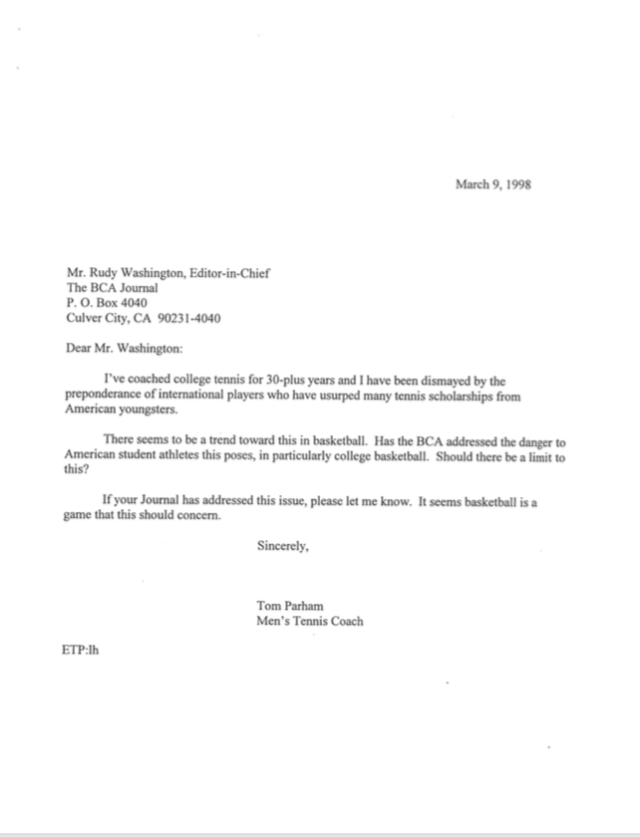
7. INTERNATIONAL IN AMERICAN TENNIS (AND OTHERS SPORTS) – BLOG 192.
8. FAULT LINES (SEE BLOG 168).
9. CHATEAU LOW RENT (73). AND , FOR A LAUGH SEE BLOG 65.
10. EVERYTHING ABOUT HOW BAD THE IRAQ WAR DECISION WAS, IS PROVEN MORE AND MORE TRUE DAILY.