A few comments on ground strokes and women: I was pre-two hander,
in 1961. Pancho Segura showed the world how to hit this shot, but
conventional wisdom said, “Two-hand backhands are only for those who
can’t hit a one-hander.” No Evert, Connors, Borg, Austin…. I’m glad many
young ones didn’t listen. Soon the tennis world realized not only can a lot
of people hit it two-handed but also it’s often a better shot offensively. The
two-hander gave many average players something they’d never had:
Offense or topspin on the backhand side. Until the two-hander, college men followed this regimen: They’d practice like heck on hitting a one- handed topspin backhand. Then, when the match was on the line they’d revert to their more trusted underspin backhand ball. There were certainly exceptions, but by and large this statement is true: “Most average college men players can’t hit a reliable one-handed topspin ball.”
Once the two-hander was “certified,” you began to see average high
school players who could tattoo a topspin two-hander and the game
changed forever, for the better. However, a valuable tool was neglected for
many. Coach Jim Verdieck of Redlands gave me one of his business cards.
It had an interesting sentence on it: “I didn’t change anything, I gave you a
new one.” I asked him what he meant. Essentially, he said the two-handers
were so protective of their newfound weapon, the underspin one-hander
was abandoned. The underspin one-hand backhand is a tool every truly
complete player should possess. Too many awkward and or short shots
(approaches, service returns, defensive cross courts) are best hit by one
hand under spinners. Often these balls are difficult to handle with
two-handed top spin “full” or lengthy shots.
Like golfers, you have to have a lot of “tools” in your bag of tricks. The
“chip” or “slice” is truly a great tool to master. Think “wedges,” golfers. And
slices are tough for little people, young girls, especially. It’s tough to add
once you’ve neglected it in the “formative years.” One reason it’s difficult is that people don’t understand the value of the “hit spot” regarding two
different backhands. The two-handed backhand is much like a one-handed
forehand, therefore, it works best when hit off the front foot. One handers
must be hit about the width of one’s shoulders in front of the front
“balance” foot.
When teaching adult women a hush would come over the group. These
strugglers with the backhand would grip the racquet just as I, yet neglect
movement to the “hit spot.” Good backhands come from good grips and
good “hit spots.” I’d bark: “Good hit spots make good shots. Lousy hit spots
make lousy shots. Lousy hit spots make wristy shots, and wristy shots are
lousy shots.”
The term “hit spot” is a direct steal from Coach Verdieck. My guess is
Dennis Van Deer’s early unique contribution to tennis instruction was
teaching pupils to understand the pupil’s adjustment to the bouncing
ball. Van Der Meer and Verdieck were friends. Once I became better at
conveying “movement to the hit spot” my players at all levels improved
quickly. And the one-handed slice may be the one most helped by proper
“hit spot.” A lot of good college men had forehand trouble because of a
subtle flaw in “hit spot.” Whereas backhands are tougher to learn, my guess
is many young boys could hit forehands with any number of “hit spots.”
Backhands, they internalized early on, must be hit “right there” or in the
perfect backhand hit spot. Then, as they advanced, a ball they tried to
hit in a faulty forehand position let them down and caused a lot of
frustration. Once I could convince them of this error and the principle of
perfect “forehand hit spot,” they’d get better too. Keeping the ball in the
perfect “hit spot” is tennis magic.
Category: C. COLLEGE TENNIS and INSTRUCTION
TWO MAGIC TEACHING SPOTS FOR YOUNGER GIRLS
Toss the ball to the service hit spot for them. Let them cock the racquet
and just hit. Once they understand and feel the proper service hit spot,
then they can add the other first part of the serve (or the toss to the
hit spot).
I taught a lesson called “Learn the second serve first.” Simply stated, a
player is as strong as her weakest link, and the weakest link in tennis is the
second serve. The clue is Welby Van Horn’s balance technique. I call it the
“hit-turn” serve and it came from limited foot movement. It’s also called a
ballistic swing and baseballers, golfers, and all “hitters” use this technique.
Van Horn is worth studying, and I appreciated the personal help he
gave me.
2. The backhand is tough for beginners. It becomes much easier if you are in the correct position.
Give the newcomer a ball. Have them start with the racket in the proper backswing position with the proper grip. Righthanders toss themselves the ball softly and slightly in front of themselves. Toss the ball lefthanded and underhanded over the low backswing, Step properly with your right foot and “lift a descending ball in the perfect HIT-SPOT. Once a player experiences how the proper contact moment feels, progress follows.
WHY, I WONDER?
One phenomenal contrast I noticed coaching girls centered on two
entirely different shots. I could hammer a ground stroke hard and wide
and was amazed at them running this tough shot down. Seriously, watch
them do this. Impressive ability. Then at the net in doubles, they’d blow a
sitter overhead. Why I don’t know, but we practiced a lot on easy
overhands in doubles, and closing on easy volleys. I taught, “volley with
your legs,” meaning to use quick movement to get the volley where you
can pop it down. The girls got better here. And when they limit their foot
movement on easy overheads, they keep the overhead in the perfect
service hit spot and watch it a little longer than you think is necessary.
(See pages 18 and 19)
DRILLS FOR GIRLS AND WOMEN
Let me repeat. There are some tough spots girls don’t like to practice.
While I preferred they choreograph these tough practices on their own,
trusty assistant Bob and I ran these particular drills a lot:
Cross court and back up. If you are hit an awkward ball or purposeful
drop shot, and you don’t want to come to the net, your best response is
to cross court the ball and back up. We’d set this ball up, the player digs in,
cross courts the ball, then scampers back to the baseline. (Bend your back
knee down to get the low ones).
Drop shot off a drop shot. Set up a good drop shot and have her respond
with her own drop shot. (Mostly down the line.)
Bump volleys. There are a lot of passing shots that can be handled with
a simple bump away from the passer. Teach your girls not to panic on this
easy ball. Just bump or touch it away from this source.
Backhand service returns. The coach hits from the “T” or mid-court,
directing the ball at the backhand of the player. Work on technique,
quickness, and target. As they progress, pick up the pace on your serve,
vary the types and direction of your practice serves. Encourage returning
on the rise or aggressively moving in.
Hitting on the rise. The better the player, the more balls she’ll be able to
take “on the rise.” Some don’t understand this tactic or technique. Some
avoid it because “it’s hard to do.” Start with slower balls; adjust to their
successes.
SERVICE RETURNS
Next to net play, the service return requires the most quickness. Good
players “unweight” or bounce slightly to ready themselves.
You have to get wide, get low, and get ready. The first part of quick is
ready!In college doubles returns are the shots that get the service break. College
kids “go for it,” almost a wide open hit. Don’t move back…move in. And
if you move wide first, try to bring your weight back to the target. (A “Z”
shaped movement.)
Often a chip shot or lob is a quality shot. Keep in mind the “tough and
tighten” return. (See Wimbledon 2014) and “Danny and the Forehand Chip”
My wife was great at helping me with the women, though she’s much
tougher than I was. I must admit that not having a daughter I missed the
true nature of young women. I’m convinced women are better people
than men, by and large, and I am grateful for the three years with some
wonderful student athletes.
There are some different issues you have to be aware of. Eating disorders
are serious and much more of an issue for women. Don’t take these
problems too lightly (no pun intended).
Sexuality in sports is a growing issue. Bigger, stronger, faster, tougher
athletes win. Most of these are heterosexual in men’s tennis. There are a
lot of great women’s athletes and people of all orientations.
TENNIS TACTICS: THE CIRCLE STINGER (65)
Here are a few observations of singles tennis strategy, some
conventional and some new. Strategy can be defined simply as how you
plan to win. Great teachers deliver memorable sound bites. Dennis Van Der
Meer: “attack the short ball.” Jim Verdieck: “get in a position to volley away from the source.” A successful high school coach once told me, “Hit it at his
backhand and go to the net.” Jack Kramer boiled it down to “Find out what
your opponent can’t do and make him do that.”
Tactics are the tools you use to implement your strategy. Coach Jim
Leighton defined the “basic unit of play” as: the approach shot, the passing
shot, and the first volley.
In Leighton’s book Inside Tennis, Techniques of Winning, Coach Leighton
pointed to Wayne Sabin’s ABC’s of Tennis Strategy:
• Hit it in
• Hit it deep
• Hit it to your opponent’s weakness
• Move your opponent side to side
While there is truth to the old suggestion of staying out of “no-man’s
land” on a tennis court, mid-court shots (approach shots, service returns,
balls hit on the rise…) must be mastered. These shots establish an
aggressive court position. Given two right-handed players, Leighton and
Sabin suggest a firm approach down the line at the weaker backhand.
This is intended to force a weak passing shot to be volleyed to the
opposite corner.
One of nine players is left-handed. The two-handed backhand is often
your opponent’s better passing shot. Differing opponents dictate different
approaches, as do your own abilities. However, there is a common thread
in all of these suggestions—tennis players are statistically vulnerable to
firm attacks on their backhand.
The success of the Spanish players, most notably Rafa Nadal, is reason to
examine a new version of a conventional attacking approach shot. Witness
the wear of the grass at Wimbledon. No longer is there a serve-volley alley
of brown on the court. There is a new pattern of wear. There is a circle of
wear just inside the baseline that indicates a shift in post-service attack Once the server serves, he takes an extra step into the court. Not to serve
and volley, but to establish an aggressive position inside “the Circle.” What
is hoped for is a defensive return. A shortened whipping, topspin ball
taken inside the baseline can put more pressure on the opponent than the
conventional, underspun approach shot. The modern player’s ability to hit
on the rise has created a new game.
A trump card, based on this idea, is the shot Nadal uses so effectively
against Roger Federer. Nadal’s shortened, topspin, cross-court attack from
the Circle on Federer’s backhand is an effective tactic. As great as Federer
is, the relentless pressure from Nadal’s stinger from the Circle eventually
yields unforced errors, a short ball, or an open court.An on-the-rise approach from within the Circle can produce more pressure than a volley from behind a serve, or a traditional underspin approach shot. The reason, of course, is that most volleys and approach shots are underspun and lack the speed of an aggressive, stinging,
topspin attack.
What about right-handers and the Circle? The answer is the inside-out
forehand, turning three-fourths or more of the court into forehands.
Running around your backhand is nothing new. While some frown on it,
given a much better forehand than backhand many players use their
footwork to turn marginal backhands into more potent forehands. The
most effective of these forehands are hit from within the Circle.
One may argue that a forehand from the Circle leaves one vulnerable
to the down-the-line passing shot, and that’s true. It’s much like the left
hander’s hooking serve to the right hander in the “add” court. When
McEnroe leftied his hooking serve there, only a few players, including Bjorn
Borg, had an ability to pass him, threading the needle to a very difficult
down the line spot to hit. But the percentages were in McEnroe’s favor, as
the percentages favor the stinging pressure of the Circle attack. (the Circle
in figure 10 is marked as lighter green, in front of number 1.) There seems to be a battle for position in The Circle in many of today’s
strategies. If a good coach teaches a player to implement the Circle tactic,
they should also teach how to defend it. Deep, well-hit service returns can
force the attacker back. Ground strokes are now required to be heavier and
deeper. These shots run the opponent out of the Circle and now you have
a chance, with better ground strokes and returns, to get yourself in the
Circle, thus turning defense into offense.
So, you now have some more shots to perfect: The Circle attacking shots
and the inside-out forehand from the backhand side. Remember you have
to have good leg and footwork to do this, and you must hit more balls on
the rise. Your goal is the Circle Stinger, which now has the advantage of
being cross court and at the backhand.
A few more tactics:
Even pros should play more balls cross court. Cross-court balls are
safer. Hit one more cross-court ball before you try a counterpunching,
two-handed backhand down the line. It is more difficult to change the
direction of the ball from a timing perspective. Those backhands are often
late, sliding wide off the sideline. Watch for yourself and you’ll believe.
As Yogi Berra has said, “You can observe a lot by watching.” I spent
another great week at the U.S. Open. Even against the world’s best
approach shots, passing shots hit soft enough on an angle create errors
or vulnerable volleys.
And while conventional wisdom says don’t drop shot on a hard
court, Federer, Nadal, Verdasco, and other top professionals now use a
forehand drop shot, hit with disguise from the Circle to the open court
of any surface. Once you establish the dominance of the Circle Stinger, this
shot becomes another weapon. It takes great touch and a lot of practice Women and junior girls should develop use of the short corners on your
opponent’s court. If I had any advice to young girl players, it would be to
make your opponent move up and back. Most girls don’t practice these
shots enough. Learn how to move up and back yourself. Practice the
footwork and force your opponents to prove they’ve done the same work.
The week before the U.S. Open, Mardy Fish beat Andy Roddick in a
memorable match in Cincinnati. Mardy played excellent defense with a
cross-court, looping, forehand flop shot. When an attacker with Roddick’s
strength is hitting a forehand so well, the flop is effective, yielding fewer mistakes. You can’t out hit some players’ best shots. A deep, looping top-
spin cross-court ball can’t be easily attacked. Great players like Fish, or Gael Monfils, swing the racquet head at different speeds. They don’t pull the
trigger until they’re in the Circle and ready to fire. Be patient.The hardest time to play is when you are ahead. I watched a top 10 men’s
player get up 30–0, 40–0, or 40–15 in several key games. But he didn’t play
those points tough and eventually lost the games. Don’t play loose points
when ahead. And don’t play loose games when up a service break. When
you do, pressure shifts from them to you. Stay hungry when you’re ahead.
A closing thought:
The point penalty system and cyclops line-calling machines have helped
control the poor sportsmanship that once damaged the reputation of
tennis as a ladies’ and gentlemans’ sport. Innovation in the rules and
technology have returned respect to the game. These are positive changes
for a great game that is still evolving strategically and is as fun to watch as
it has ever been. Let’s not move back in the other direction.
A. Modern vs. Classic Teachers
Changing to a proper service grip is an example of where this technique may be used; or playing with a continental grip for all volleys; or moving the ball toss to the right move for the service; or any number of other changes that are sound and needed. If this all sounds like it is moving toward the Classic vs. Modern coaching argument, it is. And no tennis debate is more heated than debate over the current widespread use of Western forehand and two-handed backhands. Coach Leighton invited me for breakfast with Chet Murphy at a USTA Teachers Conference. After listening to these two great teachers, I was particularly struck with one statement: Mr. Leighton asked Mr. Murphy what his assessment of the classic method of tennis instruction that their careers had sanctioned. Mr. Murphy pondered, then responded, “I think we did a good job, though we probably should have been more tolerant of Western forehands.”
It is tough to be a “purist” today. There are so many varied and successful styles. I don’t think there’s a stroke Greg Holmes (1983 NCAA Singles champ) didn’t use. Borg, Evert, Connors, etc. all use some shots that vary from the classic or Ken Rosewall style of play that so many used as “copy” for years. Many of the variations offer improvement, and certainly there is a “classic” way to hit any shot, new or old. One problem some teachers have is that many played before these new “inventions” and we have to “retool” our knowledge. Coaches to follow will have the same task.
Welby Van Horn took time to talk tennis with me at the summer resort in Pinehurst (North Carolina). One of his concerns is the lack of proper “copy” for young players. Who to imitate becomes a modern problem that perhaps players from an earlier era did not have. There has always been copying or imagery, but never has there been such a wide panorama to choose from.
HELPING HIGH SCHOOL TENNIS COACHES
NC TENNIS—HELP FOR HIGH SCHOOLS COACHES
I attended the NC High School’ s tennis coaches clinic in Greensboro last week. This is held and hosted on the UNC-Greensboro campus with Coach Jeff Trivette as chairman. This is the first time in a while I had attended and was impressed as Coach Michael Leonard of Elon University put on a superb doubles clinic for some 150 high school coaches from our state. I attended the first tennis clinic the North Carolina High School Athletic Association held. Wake Forest coach, Jim Leighton was the clinician and there were four coaches at the Latham Park courts. That clinic was the beginning of a different level of desire to be a good coach, for me personally. In 1985 I put on that clinic.
I watched the progress that has been made in high school tennis in our state. The Burlington Tennis Center was and is the site of many state championship tournaments so it was easy to watch many of these.
As I watched the clinic this year I told some one “…there is a lot more CARE in that group than knowledge. Granted several of the coaches demonstrated good skill on the court. I have said all along that a high school coach who cares and drives the van properly is all parents can hope for. Now I think it time to help them. They , by virtue of their attendance and willingness to coach our children, have earned our assistance.
HOW?
Much is already being done. The NCTA , The USTA, The NCHSAA, The North Carolina High School’s Coaches Association are going hard to help. Where help is needed comes from several sources:
**** Pay for these jobs is meager compared to what is asked and expected.
****The pay will not attract top notch tennis coaches in most instances. Most of the very good ones are volunteers, or close.
*** The typical “assigned” staffer is often a football coach, one who knows nothing about tennis. Or some similar scenario.
****More and more are “adjunct”, or part time coaches, who don’t have even the academic background that teacher/coaches have.
WHAT CAN HELP?
One way to start is a “THINK TANK” or committee to examine what is possible. We have a tremendous group of fine players throughout the state. We have in place an organization of teaching professionals in NC. Many times the best source is a “tennis angel” who silently plays with youngsters. No one gives more than parents. The club pro benefits from high school families.
There is another largely untapped source in our state. The NC TENNIS HALL OF FAME members. There seems to me to be a group of old pros and young turks in our select group who could also help the coaches in their area. Many of the hall of famers and pros are the same people. Many already give or have given to tennis in many ways. There are so many ways these people could enhance the knowledge, confidence, and performance of particularly the beginning coaches. I can’t list them all. Believe me, you can help.
I would also suggest to these coaches to look for the local angels. My experience is these are great people who only need to be asked. It may be one afternoon a week, It may be a helpful phone call. Showing a drill, filling in for an emergency, play an exhibition, take them to a college match, gift of equipment—old or new, simply attend matches, etc.
I think a good place to start “thinking” would be the coaches, the Pros, the angels ,and the organizations to brain storm the how. The why is obvious. And I think there is ample evidence that this help is available. And I am convinced the link between high school and juniors and parents and these volunteers can thrive.
The first place to start is knowledge plus need. Our hall of famers and our professional tennis teachers are where to start.
WHAT DO YOU THINK OF THIS? WILLING TO HELP?
These Rang True
Here are some quotes on strategy from people I respect. These “rang true” for my many players in many matches.
Find out what your opponent can’t do, or doesn’t like to do, and make them do that.” Jack Kramer
(Think Nadal over Federer in 2007 French Open. Target? Federer’s backhand.)
Don’t change the “line of the ball” unless you are sure you can make the shot. Otherwise cross-courts “ad nausea.” Two-handed back- hands down the line shots will “slide wide” too often, believe me. T. Parham
When asked what he would do differently, Ken Rosewall replied, “..I would hit a lot more balls cross court.”
Cross-courts get you out of trouble. Jim Verdieck demanded the cross court ball from his team.
Get yourself in a position to “volley away from the source” Verdieck
Any ball hit extremely deep in either corner allows a good attacking possibility Verdieck (“2 and in”)
The simple strategy of tennis singles: “Attack the short ball” Dennis Van Der Mear
Good approach shots make easy volleys J. Leighton
No shots in “no man’s land” is a myth T. Parham
Rule 1 – Find a good doubles partner
Rule 2 – Get along with him/her
Thoughts for Young Coaches
Recently, an Elon graduate, Kyle Smialek, and his family donated tennis scoreboards at the Jimmy Powell Tennis Center on the campus of Elon University. Graciously, they named the scoreboards in honor of my assistant, Bob Owens and me.
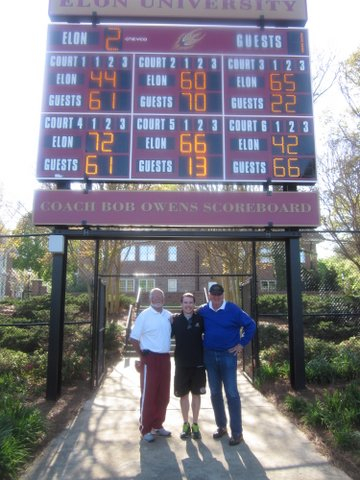
Kyle’s mom, Jill Smialek, wrote me with this nice email:
I am hoping you will be be there!! Kyle is going as well as Kaylyn.
If it wasn’t for you my Children wouldn’t be going and there might not be a scoreboard!!
But, God bless you, you had given him a chance – and to his credit he followed through for four years. Because of your dedication which you have passed on to my son. He never gave up. He was Elon inside and out.
Tom, you have given my son the determination to try his best. He may never had been given that chance if it weren’t for you. He may not ever made it “big” in college tennis but his loyalty and his determination is admirable. And that loyalty drove Kaylyn to try her best at Elon. And again she struggled with tennis but never gave up!
I attribute that determination to you. They have both grown through Elon tennis and have now become successful adults. Two Children that make me very proud of their accomplishments.
So when you are there – look at those scoreboards and know you made a difference on not one but two people’s lives. You deserve that scoreboard. Enjoy it!!
Hope you get to catch Kyle and Kaylyn while there.
My very best to Margaret
Cheers,
Jill
I responded with the following email and the thought, “One parent is worth more than 100 teachers…”
Jill–what a kind note and thanks. Here is an alternate explanation for the kid’s successes..In James Michener’s MEXICO, Michener uses bull fighting as a metaphor for death…he asked the reader “…what is the worst thing that can happen from a promoter’s point of view?” Answer: The bull must have courage or he won’t fight! Picture “Ferninand the Bull”. Next question—what is the surest way to determine if a bull has the necessary courage? Practice fight? Can’t do that, because one practice and the bull figures the deal about the cape out. Kills the matador. Promoter’s best guess at determining the potential courage of a young bull? Fight the mothers…if the mother has heart, the offspring will have courage. You did good with the kids, Mom. Jill, I loved Kyle as a person and you all as a family. I’m glad, but not surprised about their success. Margaret and I are quite thrilled about the scoreboards and look forward to seeing them in action. (Hopefully with some Phoenix wins on the boards). I must tell you and your family that as much as we appreciate our names up there with Elon, our most intense thanks are for the remembrance of our beloved friend, Bob Owens. I truly believe Bob is an angel. Can’t wait till next weekend.
Stay in touch, and thanks once again.
Tom and Margaret Parham
The Smialeks think I did Kyle a favor by keeping him on the team. It was a “no-brainer.” First of all, he was a good player. More importantly, he was a heckuva fine student and person.
But I started to think about unsung contributors who often don’t get to play much. Football coach Henry Trevathan is a dear friend and legendary coach. I once asked Coach Trevathan what he liked most about coaching. As was his way, he pondered the question a while and finally said: “There was almost always a kid trying out for the football team who had no business trying out; too small, lack of talent, slow—whatever. But he had one quality. He wouldn’t quit. I somehow could keep him around and turn it into a positive for him, the team and myself. Took some time, some patience, some faith.”
I had several of those kids who’d played for me, Kyle was one, his friend George Memory was another. George’s family, the Don Memorys, are part of the “Memorys of Wake Forest College”. Bull and Jasper Memory are iconic at “Old Wake Forest.” They were also tennis players who took my father, E.T. Parham, under their wing when he was an aspiring young theology student and ministerial hopeful. They taught him tennis and he played #4 for Wake Forest in 1928. I met Don Memory socially when George was a senior in high school. We uncovered our connection and I learned that George was interested in Elon. We got him to Elon and he was a “marginal” player who I kept on the squad. The summer of George’s second year I checked my returning player data with Elon and George was not enrolled. I called his Dad and I don’t believe Don would object to me saying there were “tears in his voice” when he told me that George “had worsened” (he suffered from severe kidney problems) and would not be able to play anymore. And he was not going back to Elon. I encouraged both to have him come back. I would keep him as manager and “in” tennis—a game he loved.
Fast forward two years, George’s health had thankfully improved and he was able to return to the team. We were playing Davidson; they were good and it had taken all of efforts to win. George and Kyle Smialek were up to play doubles together in a “scratch match”. We may have already won but you’d never know watching Kyle and George. I don’t remember much else about that day, just that our team won, it was beautiful out and that watching Kyle and George play together made a lot of sense. It was a tremendous jolt of joy, for me as well as the team.
I did my share of winning. It is worthwhile to do your best. I remember a lot of these “Smialek” moments and what great kids some of these non-starter, marginal players were. Many of my era’s kids would have played on a lot of fine college teams but were bumped by the influx of foreign and international players. My first team had great guys who would not have played later. However, given the chance and some time, they blossomed with experience. Joe Roediger was #13 on my first Elon team. He worked his way up to #5, graduated when no one thought he could and has taught tennis for twenty years. No one loves teaching tennis more than Joe. Many of these marginal players ended up as teachers and coaches. The ones who are cut, end up bitter at tennis and probably quit playing, let alone teach it. The marginals though, will possibly be your next great tennis teacher, pro or coach.
One of the few things that I did not like about Title IX was that it dictated squad size for men be equal to women, or vice versa. You had to cut at a certain equal number. Until then, I could let them hang around as long as they would. Coach Jim Verdieck of Redlands University and our NAIA days, kept 32 on his squad. He gave the top 16 a private hour lesson weekly, the bottom 16 a half hour. Many of these “subs” are teaching today. Plus, Verdieck won more national tennis titles than anyone, ever, in college tennis.
I did, of course, kick a few off. None who didn’t deserve it. And I kept a few I should have run off. Maybe I was idealistic but I thought they could all be salvaged. Very often, a challenge match cost a kid a starting slot, or a chance to stay on the team. One kid lost a challenge match on the match point of a third set tiebreaker—on a double fault. That hurts. But he didn’t quit and eventually became a fine starter. Almost every kid I kept, sooner or later, came back and got me a crucial win. Peter Van Graafeiland lost and lost and lost. He was as nice a kid as ever played. He figured it out and became solid at the bottom of the lineup. Jon Hodges, Ashley Shaw, Justin Clark and Micheal Prelec were Americans who sat out until their time came. John Morel grew 4” in his freshman year and was ineligible. He later became all conference.
So many more examples, Chad York teaches at one of the better tennis clubs in Charlotte. He took lump after lump and it killed me to watch him come up short. Chad never blinked, to this day. Tommy Stratford teaches tennis in D.C. He would bleed to play and always, always supported the team. Tommy Nielsen was the same. A guy named John Potanko was recruited out of PE classes. Andrew Hodges teaches today. I watched him play freelance everyday while we practiced. I convinced him to come over to the varsity courts, hit with some of the better players. He didn’t think he was good enough. Great kid. Kevin McCabe was another. Sebbe Bredberg, a Swede, fought shoulder problems and substituting for a school year. Next go—Southern Conference Champion, Bredberg a hero! There were similar kids at Atlantic Christian and really I’m sure I’ve forgotten several.
I wrote this thinking of, and thanking, the Smialeks. More than that, thanking my persistent kids. I loved seeing them make it. More than either, though, I write this for the young coaches… “Don’t cut ‘em, Don’t give up on ‘em, Coach ‘em, Coach ‘em, Coach ‘em!”
 The Little Green Book of Tennis