MOTHER AND CHILD REUNION

“How many times have you heard someone say,

if I had his money, I’d do things my way!”

Patrick Mouratoglon,  Serena Williams’ tennis coach, said it.  The commentators missed a great chance.  Was the USTA listening closely?  His point about Co Co Gault’s win over Venus Williams was, here is another example of where great American tennis players have come from, then and now.  What better example could you want:  From Richard Williams and Venus and Serena, to 2019 Wimbledon and Co Co and her parents.   The Bryan brothers and their dad,  Isner and his mom, all the  way back to Chris Evert and her father.  Connors and mom.  McEnroe/Father.  No one gives their attention to a child like  parents.   There were five American men entered in the 2019 French Open.  Tiafoe, at #32, was the only seeded American male.  Taylor  Fritz won a first round match.  The rest lost.

For the umpteenth time,  all entities sincerely interested in developing quality American tennis players, should demand a reasonable slice of college tennis scholarships for American students.  Parents need help, a carrot at the end.


Former college tennis players
Jack Kramer, Arthur Ashe, Stan Smith, John McEnroe, Bob and Mike Bryant, Jim Courier, Brad Gilbert, Bill Tilden, Roscoe Tanner, Jimmy Connors, Dennis Ralston, Dick Stockton, Vitas Gerulaitis, Michael Chang, Malavai Washington, Todd Martin, Bob Lutz, Bill Talbert, Tony Trabert,, Vince Spadea, John Isner, Steve Johnson, MANY MORE.

AMERICAN TENNIS IN THE FUTURE

  1.  College tennis is directly related to the development of elite players in America.  Without more scholarships for our youngsters,  we will continue “the dearth”.
  2. Pickleball could be an obvious first choice as the best lead-up game for our junior tennis programs.   The mass of people are unaware of our  current programs to address junior participation.  Awareness of pickleball popularity grows daily.

FOREIGN TRADE OR FOREIGN AID

The IntercollegiateTennis Association is the NCAA affiliate that manages college tennis in large part. Periodically they rank the teams, and singles and doubles

They rank men and women in NCAA Divisions 1,11, and 111, the NAIA, and Junior colleges. Having just read these 2018 fall rankings (google ITA TENNIS) and anyone can see the listing of the top players) my observations of these current lists reflect the long time history of college tennis:

  1. I once asked a player of mine who had just won, who he played next? Another “strom” he said. Lots of Ovas in women’s tennis now.   Lots of oriental names in women’s LPGA?   Don’t see as many Reggie Williams or Sol Epsteins. It is not the Smiths and Jones who are on the lists. And taking the scholarships.
  2. Sure, Americans are great mixture of people and names, but believe me, I have studied the lists a lot, and the rosters that reflect their nationality . Pick a school, google men’s tennis . Tag the roster and see for yourself. Just recently I researched the total rosters of Division 11’s top six mens teams. Of 63 players on the combined rosters, 62 were international. Six schools, one American. When I saw the USTA figure of some 25% of college tennis players being internationals, I cringed.   TRY 80% of top players.
  3. No scholarships for American kids, no elite players. Our great players, past and current, come from parents, high school and college tennis. Not Academies or the USTA.
  4. Is diversity our goal, or winning, or our children? Scholarships are the answer. Should our kids get the lion’s share.?
  5. Is this spreading? Like kudzu !!! And the most cruel sport is basketball, given the need of the players.

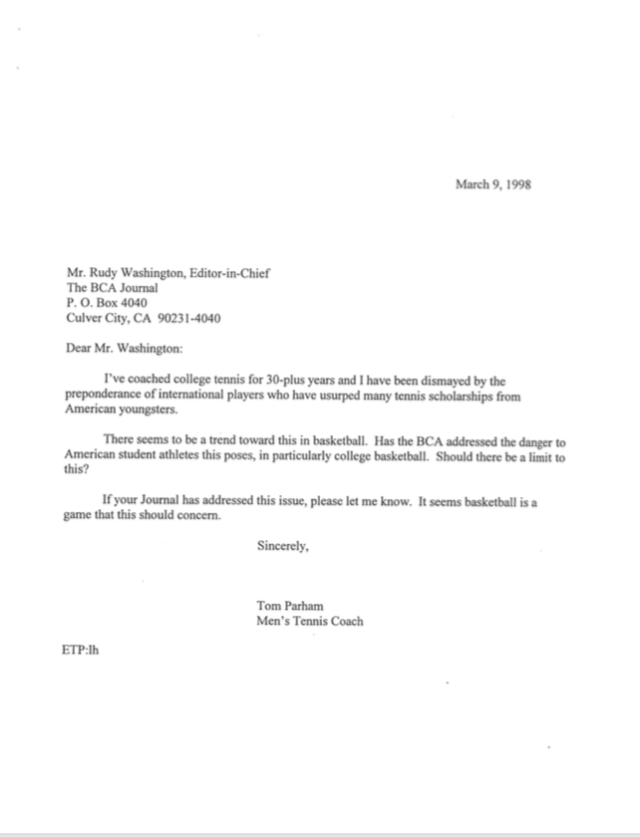
In 1998 I wrote the BLACK BASKETBALL ASSOCIATION (BCA) acknowledging this change. A copy is enclosed. Twenty years! Who will be playing on our collegiate teams twenty years from now.

Screen Shot 2018-12-26 at 10.33.12 PM.png

THE 2018 US OPEN (TENNIS)

Now retired from coaching tennis, I marvel at the changes in the game. The US OPEN men’s singles match between Nadal and Theim may have been the longest match ever played at that level of play. In 2012 it was apparent the next tactical gold mine was the drop shot. Now they have perfected how to defend this nightmare. What is next?
1. Temperature control. Eight players retired with heat the victor in early play.
2. Two of the all time best (and toughest) men–Federer and Nadal were victims, one to heat, one to injury. The parity of the players, and the number of them, has combined with technology to the point that even the fittest succumb. Somewhat like pro football, who is left at the end, wins. Most obvious first rule change: Only 2 of 3 sets.
3. There were no referees in small college team tennis matches when I began coaching. Players made all calls. The home coach was in charge of decisions. Some “goat rodeos” in those days. The point penalty system gave our new found referees a way to control misbehavior. Took a while. Illie Nastase shouted at the “cyclops” prototype “…you made in Russia!” The new machines can make a call as narrow as a blade of grass. Little arguments with modern line calls.

RE -EXAMINATION, APOLOGIES AND RE-AFFIRMATIONS

  • I apologize to our women.   USOPEN SEMIFINALISTS!
  • Few good Americans develop without high school tennis.
  • Girls high school teams and girls of limited ability are the most neglected learners and often the most receptive.
  • The maturing of our women’s league players, coaches, and administrators is a gold mine of help for high school girls teams.  Boys too.
  • There are a lot of different ways to help our high school teams and coaches.
  • The two  toughest teaching spots are  developing  a working one hand backhand grip for 1. the slice and 2. the advanced serve.

THE SCIENTIFIC METHOD, RECIPES, AND ALGORITHMS

Mr. Wilton Powers taught us the scientific method in the 9th grade.  Seems very similar to the popular “algorithm” .  Or Mom would suggest –recipe.

The “domino effect” is another term anyone my age is well aware of.

Both apply to sports in American colleges today.   Watch what happens when a top tier basketball coach changes schools.  The next guys down the chain apply, one is picked and the chain moves down a rung.  And on and on to the last Division 111 coach doing it the right way.   A similar pattern is all too often repeated among D1 mens basketball players. Called”one and done”, it is more widely understood than algorithms.  One that makes many coaches jobs less appealing?

IS THE FOLLOWING AN ALGORITHM?

  1.  Collegiate athletes graduate, quit or somehow vacate a scholarship.
  2. The coach recruits the player best enabling him to win, or keep his/her job.
  3. The best players take the best scholarships and accrue the best education available in the USA.
  4. They return to wherever, educated.
  5. Those down the chain get a lesser education.

In Division 11 Men’s College Tennis (2017) the top five combined team’s rosters housed 63 total players.  Sixty-two  are international.  How far down the chain must an American tennis player go to get what’s left?

“DAY DREAM BELIEVER”

What if Americans received more grants ????

 Would these things happen—
1. Would families come back to tennis?
2. Would these grants lighten the spiraling cost of college to our families?
3. With grants available would we halt the downward spiral of quality players?
4. Couldn’t Internationals still play if they paid the bill?
5. Wouldn’t our college programs develop our top kids (they do that now for internationals, and we pay the way). And they did so before grants were lost.
6. Wouldn’t our top kids have a shot at top notch education at our better institutions?
7. How about USTA membership? High school tennis, Coaching quality and opportunity?
8. Players would gather the life lessons of a great sport. The game is the best teacher.
9. Our kids would win more, and especially benefit from being on a team that has a chance to win.
10. All-Americans that are American?

THE GUERRILLA BUREAUCRAT

THE GUERRILLA BUREAUCRAT

“You’re gonna need a bigger boat” (JAWS)

To change an organization you need someone powerful within the organization to champion your cause.
My “cause” is American children and college tennis.
The problem is the decline of high quality players in America.
I am not alone. It is commonly discussed, but “… the wind is blowing but the trees ain’t moving.”
I was advised long ago, by the CEO of the NATIONAL ASSOCIATION OF INTERCOLLEGIATE ATHLETICS, having lost my argument, “,,,you are right, don’t quit!”
My guess is the missing link to convincing the “Gorilla Bureaucrat” is data.
To survey the issue of change someone has to collect the data (it is certainly there) which would take passion and funding.
Here is what I speculate and how I would begin to collect the data:
PREMISE :  American tennis players would improve drastically if college tennis scholarships were not given predominantly to internationals.

Plan
1. Collect data (where, what, how?)
2. Where? The major divisions in college athletics are NCAA, 1,11,111, and NAIA (smaller colleges), men and women. Coaches, Athletic Administrators, Sports Information Departments, Conferences and National offices, local media, the USTA, The Intercollegiate Tennis Association (ITA), tennis publications, the players themselves.
3. What? EXAMPLES
***Rosters from the past. Top eight teams, top eight players’ homes. How many scholarships were awarded and to whom. Percentage of allotment awarded to internationals? State or private institutions.? How much to in-state players.
****Conference and National records: Who won the team titles and how many starters were American. Singles winners? Doubles winners. How many all conference selections went to Americans? How many All -Americans were American, year by year. Rankings year by year by the ITA (Their homes towns), Seeded players in National tournaments (homes).
4. How? The rub lies herein. Someone has to do the work. Someone is going to have to pay the bills. Who should? The NCAA and the USTA for sure. Private money from those who love tennis and our kids.

Problems?
1. The first question is, is it legal to reserve a % of scholarships “off the top” for our kids? This will likely have to be litigated. Care enough about your children, to risk court action and expense, tennis?
2. You would eliminate some great international people and players. Them or us?
3. The quality college of tennis players would go down for a period of time. However my belief is the quality of American college players, juniors, and pros would eventually improve. And I am almost positive attendance at college matches would grow rapidly.

THE LINE CHART

The NAIA had a 1 foreign player limit in 1970. Once the door was opened wide it spread to all levels, men and women. And with other sports joining in, men and women.
Between 1970 and 2016 there have two stark developments. Scholarships for Americans have plummeted and American player quality has done the same. My chart on the issue would look somewhat like this. Facts would confirm nearly on the button (MY GUESS).

*****CHART (reflects two variables for the years from 1970 to 2016: (1) Scholarships to Americans at top tennis schools and (2) the quality of America’s top pros.

The tennis “boom” began in 1968 (“Open” tennis”). There were several nations that produced many great players in the next 30 years. The Australians, the Swedes, Spain, and certainly America. I have two blog articles posted on http://www.tomparham.wordpress.com, , that roughly lists Americans who were in some way influenced by American college tennis (blog 114), and year by year listings of the top ten pros (blog 113 ).

The other dramatic chart would be to compare top ten ranked American pros annually from 1970 until now. Name the top ten women today?
In the 70’s and 80’s the men’s number 6, 7,8 etc. featured names like Connors, McEnroe, Ashe, Tanner, Ralston, Riessen. Our top eight would have a shot at every major. For the last 5 years no American man has made it to round 3 in any slam. ***(Sam Querry just made Round 4 at Wimbledon).

Where are these guys? Arthur Ashe, Stan Smith, Jay Berger, Harold Solomon, David Wheaton, Patrick McEnroe, Todd Martin, John Sadri, Bob Mckinley, Brad Gilbert, Michael Pernfors, Peter Fleming, Clark Graebner, Brian Gottfreid, Dick Stockton, Charles Pasarell, Jack Kramer, Chuck McKinley, Bob Lutz, Rafael Osuna, Tony Trabert, Barry McKay, Frank Froehling, Vic Seixias . Cliff Richey, Brian Teacher, Jimmy Arias, Aaron Krickstein, Paul Annacone, Elliot Telscher, Tim Wilkison, Andre Agassi, Michael Chang, Jim Courier, Pete Sampras, Malavai Washington, Vince Spadea, plus many others.
***These people have had close ties to American college tennis. Some went on to coach in America and at American colleges. Many of these were internationals who came to American college tennis and honed their skills to the professional level. Most would not have done so without scholarships and the collegiate experience. Our Davis Cup team just lost to Croatia! There were fifty men who played on this year’s international Davis Cup zonal teams who were, or currently are, on American Collegiate rosters. No doubt with grants we subsidized. More clearly: We are paying them and training them to beat us. Reminds me of POGO (…we have seen the enemy and it is us!)

***My career began before Title IX and women’s intercollegiate tennis. As late as 1970 there were some women on men’s teams. The women followed suit as far as recruiting internationals. My knowledge of their players is limited, thus the article above comes from the men’s teams.

Conclusion: Is there a “Big Gorilla” who shares these concerns?
1. THE USTA? They have the money to go to court. Their mission is heavily oriented to our young people. It is the “United States” Tennis Association.
2. THE NCAA? They have money too, but their real efforts are toward big money sports. Would they risk a lawsuit? Are they “actors of the state?” The “National” Collegiate Athletic Association?
3. THE ITA? Would most of their members vote for American inclusion? They did one time!
4. MONEY? What if major private money wanted more Americans, Ameican quality players? Example? Oracle is now sponsoring college tennis. What if the CEO (Larry Ellison) felt strongly his funding should include significantly more American support?
5. TAXPAYERS? Nationally, state, local? Just another form of foreign aid, not trade?
6. INSTITUTIONS? Why is my donor money paying for them and not my kids. Isn’t this an unnecessary add-on to runaway tuition?
7. PARENTS? You wouldn’t offer my kid any help, yet your roster is totally international. And you often lose.
8. SMALLER SCHOOLS? When will Presidents, Athletics Directors, Trustees realize “we are just giving our product away”. The “arms race” in minor sports yields little, costs tons.
9. STUDENTS: My athletic fees are supporting those people? Are they helping with my student loan?
10. TEACHING PROS AND HIGH SCHOOL COACHES: No more kids taking lessons, buying products. No more kids going out for my team. Better kids electing other sports.

I also hope The National Federation of High School Athletics would weigh in with their concerns and data for not only tennis but all sports.

JOBS

THIS JUST IN FROM “SB NATION”.

“International players ruled the draft

There were 14 international players selected in the first round of the 2016 Draft, from Dragan Bender at No. 4 overall to the surprising Georgios Papagiannis pick by the Sacramento Kings near at the end of the lottery. That’s an NBA record for the first round for international players, although six of those 14 were attending colleges in the United States last season rather than playing overseas.

The NBA brags about being a global game as frequently as it can, but if a record-setting international haul doesn’t prove them right, then what will? Basketball is becoming more globally accessible and more young athletes are attempting to make the move into the NBA, which can only be a good thing.”

14 BUMPED AMERICANS. HOW MANY KIDS ARE BOUNCING THE BALL WHO WILL RUN INTO THIS EVENTUALLY.