PUT ME IN, COACH ( 14 )

2022 offered some silver linings in the American efforts in elite player development. 2023 ( French Open starts the rock throwing again : No Americans in the running! )

Forgive the pilvering: I can’t find the true author of a recent attempt to identify American shortcomings and causes in player development. Several systemic flaws listed are capsuled : Inadequate care of player’s injuries—lack of parental involvement—motivation and mental toughness—lower birthrate—lots of other attractive sports.

The first and main problem listed is described this way:

“… if you don’t start out with a trust fund, you’re stuck, especially for a sport like tennis that requires years of youth investment. This is a major, fatal disadvantage for American tennis. In Europe, South America and lately in Asia, kids from all social classes have a shot at a tennis career. If they show sufficient talent and motivation, there are numerous community organizations, government programs and general social assistance systems to help build up their careers, in part because these other societies strongly support investment in their youth. “

My inclination is to cite #1 as the core flaw to be dealt with.

“After all is said and done, more is said than done~” a.k.a. –What can we do?

Here are two starting suggestions:

  1. Reserve a large portion (50 % ? ) of college tennis scholarship aid for Americans.

2. Support Hgh School boys and girls varsity teams.

High School teams are one place that participation is relatively inexpensive,

The coach is the key.

Team play adds a whole new element to the process. And teammates share the pressure.

A tremendous wealth of knowledgable people could help the coaches. players, teams, and parents.

This is not going to be easy. Money, Time, and effort are “musts”.

THE HARDEST THING TO GET IS GOING!

“JUST KEEP PECKING AWAY AT IT!”

THE KING OF ROCK AND ROLL ( 15 )

There have been a couple of documentaries lately about LITTLE RICHARD.   He was a leader in the Rock and Roll “Boom”  in the mid to late 50’s .  Fats Domino, Chuck Berry,  Ray Charles, Ruth Brown, LaVern Baker, Marvin Gaye.  Many other “greats”.  I think Little Richard was the first to claim he was The King of Rock and Roll, but others entered the show by wearing a king’s crown and dancing down the aisle once the red carpet was laid down for this “king”.

About ten years later (1968 )there was another BOOM—-“Open Tennis !  The professionals could now enter the tournaments.  The timing could not have been better.  One reason was television.  Tennis fit the screen perfectly.   The Australians led the way,  Borg and the Swedes, Spaniards.  Connors, McEnroe, Sampras, Agassi, Evert, Austin’.  Tons of Americans fueled the  craze,  Craze ? Boom?  You Bet!

 And it wasn’t just the players .  A whole new market developed.  Sure enough  everyone needed some lessons and a green Yonex.   When the USTA  hosted a coaches clinic along with the USOPEN, would be “Kings of Tennis Teaching” cropped up from everywhere with “the way, the truth and the light !   From Elmer Gantry to Dennis Van Der Meer.   Spreading like Kudzu or Pickleball.  

So—1968 until 2023 —Who is the King ( or Queen ) of Tennis Coaching/Teaching ?

Good News:  By and large the boom created an intense ,competitive, effort to learn, to earn, to win.  

One high school coach proclaimed “…I can earn more teaching tennis in the summer than painting the classrooms or teaching Driver’s Ed”.  

The surge of interest  caught the attention of science, particularly sports

 oriented scientists.  Diet, psychology, —-all of a sudden winners thanked  “my team “

Technology is about to radically improve the game.  

Still there is BAD NEWS.  

Where did you go Joe Dimaggio?

French Open 2023 (last week)  ROUND OF 16 WOMEN- American Women ?  One —CoCo.

American  Men ?  zip, zero , nada. 

With the exceptions of Venus and Serena there has been no USA in “winning “ for decades.

As the old saying goes “… if we so smart, why ain’t we rich? “

Where did we go wrong?  What can be done about it?  What can I do about it ?

Last year several American men gave us a glimmer of hope.  Tommy Paul,  Francis Tiafoe, Taylor Fritz , Sebastian Korda provided impressive “shining moments”.  Their training included the THE ACADEMY method of living, lodging, and practicing with master teachers.   The latest French Open  Draws had 11 men and 6  women in  singles who played some college tennis.  The COLLEGE method is strikingly like an academy that houses, feeds, finances, with professional coaches and hopefully education too boot.   Even one season of college play affords an often needed extra year to develop one’s game.  Think “redshirting”.

John Isner Is a North Carolina product of the FAMILY METHOD.  John stayed at home, played high school, then college team tennis.  Scholarshipped to the University of  Georgia, John is quick to credit those 4 years as gateway to our finest player’s success.  

And,  historically , the FAMILY METHOD produced  a large portion of elite American players.

There is no limit on the number of internationals playing college tennis.

  And the number of and percentage of internationals awarded scholarships  is staggering.   We have paid for their training, while abandoning our own.  And quite often at tax-payer’s expense.  Many of these go from college play to the pro circuit.

My guess is that some form of this conversation has repeated itself between internationals:  Player 1—“My country would not scholarship non-citizens like America!”  Player 2.  “Mine either.   Can you believe how they simply gave college tennis to us?”

What should we do?  One suggestion is to reserve at least half of our scholarship money for our kids.

Player development is expensive.  Profitable playing careers are  truly  rare.  Scholarship aid is the only reasonable way to recoup expense. 

What can I do?  

Having quit a job that I wasn’t suited for, I was advised to “ Do what you can do!”

I payed on every team that would give me a uniform. Little league, high school, two varsity college teams.  Coached basketball and 40 years of small college tennis.  

Along the  way there were tons of hours on the  court.  And most with fine college players.  Yet camps, recreation classes , club pro and public tennis, yielded a laboratory  for all levels of  players. 

A lifelong North Carolinian, retired at the beach,  The “what can I do “question  was answered by —-HIGH SCHOOL TENNIS.

I believe in TEAMS.  Team play. Sacrifice for my mates.  Playing for my school.  

I know that the coaches need help that we can give.  Some schools can’t find anyone to coach teams.   THE ARE MORE GIRLS PLAYING HIGH SCHOOL TENNIS THAN BOYS—yet finding girls  teams a good coach is particularly tough.   “The route to the most improvement is through coaching the coaches”.

 I dream we will scholarship our kids first. 

I suspect scholarships are the best bet to motivate our people  to invest what is needed to

get to our share.

BORROWED TRUTH ? (16 )

Right on ., Michael H

Mike H

Youth Tennis Coach for More Than 35 Years

RelatedWhy is professional tennis dominated by players from European countries?

As a US tennis coach at top training programs for more than 35 years I can answer this decisively, as I’ve personally witnessed this dispiriting fall from the United States ruling the tennis world to becoming an also-ran since 2003—and it has little to do with “training on clay”, “the everybody wins culture”, “new string technology” or the usual excuses, the reasons are much broader and deeper problems in American society and sports preparation.

  1. The American “class bias” in tennis and the general collapse in America’s youth investment and social mobility. Tennis classes and equipment can be expensive, costing thousands of dollars a year, but in America, if you don’t already come from a rich family, you’ll get squat as far as help or assistance for your career, or you’ll be forced into debt. The USA has basically rejected the idea of community youth investment, for sports and in general, the same reason our college grads have $1.4 trillion in student loans for essential education. This is a dramatic change from when I started tennis coaching and it’s part of the general shift of America away from a socially mobile society to a practically feudal aristocratic one, that has pulled up the ladders for its lower, middle and even many of its “less than rich” upper classes. The short version: if you don’t start out with a trust fund, you’re stuck, especially for a sport like tennis that requires years of youth investment. This is a major, fatal disadvantage for American tennis. In Europe, South America and lately in Asia, kids from all social classes have a shot at a tennis career. If they show sufficient talent and motivation, there are numerous community organizations, government programs and general social assistance systems to help build up their careers, in part because these other societies strongly support investment in their youth. Even those who don’t show initial tennis promise are encouraged to keep at it, and many go on to develop that talent later on. Thus the other countries have a much greater talent pool and motivated, mentally tough kids from the lower and middle classes who see tennis as a shot to a solid career as a professional athlete and a tool for social mobility. Myself and a number of other coaches do what we can to provide free or reduced-cost tennis lessons to kids without major means, but every year we realize how much we’re swimming against the tide in the US, compared to our European and South American counterparts for whom there’s much more community support to assisting kids from all social classes.
  2. The US healthcare and general health insurance mess. Anyone who’s followed the careers of tennis athletes from the Top 100 through the Challenger Tour and Futures Tournaments knows that injuries happen in tennis. A lot. So good general health care and medical assistance are a must. For Europeans, South Americans, Asians and Aussies this isn’t a problem, when you get injured, you simply go to a physician and get the problem fixed, and you’re back on the court with no financial hardships. In the USA? If you get sometimes even a minor injury on the court, let alone one that requires surgery, you can be set back tens or hundreds of thousands of dollars out of pocket, even if you are insured! I can’t describe the frustration of seeing great tennis prospects going bankrupt or losing their savings due to medical bills from the lunatic American medical system. Again, the breakdown in American tennis is due to a much more fundamental breakdown in American society and policy, and until this is fixed, America will not have a tennis resurgence.
  3. Parental involvement and family leave. Again this is a broader societal problem that has trickled down to throttle America’s tennis competitiveness. in Europe, Asia and parts of South America, parents are able to take advantage of a variety of family leave policies that allow them to take off time from work without a major career penalty, and focus attention on their kids, including taking them to tennis practices and academies and generally just being with them as they improve. America has Third World parental leave policies as well as skyrocketing costs of living that force both parents to constantly work or search for jobs when the economy is down, which then makes it impossible to help nurture kids’ budding tennis talent. The result? Very depressing and I see it all the time. A budding talent simply doesn’t have the family support network to do the little things that help their talent develop, causing them to get frustrated and quit.
  4. General lack of motivation and mental toughness, maybe associated with all the social media obsessiveness today, from my observations much more in the US than in other countries. I was coaching US kids intensively back when Andre Agassi, Pete Sampras, Jim Courier, Andy Roddick, Todd Martin, MaliVai Washington and Michael Chang were rising through the Juniors Circuit, and worked directly with a number of kids out of the Bollettieri and other top academies. Those guys and girls were motivated to get better and better, building up confidence and not being rattled by setbacks. Today, there just seems to be much less patience for that sort of thing and a lack of the sustained attention that’s needed to become great at the sport. This applies to both the men’s and the women’s game—once Venus and Serena Williams retire, we just don’t really have anyone else of their sustained discipline and drive. On the men’s side, Jack Sock, Steve Johnson, Donald Young, Sam Querrey and John Isner— and potentially Frances Tiafoe, Noah Rubin, Ryan Harrison, Stefan Kozlov, Tommy Paul and Taylor Fritz— certainly have a lot of the right stuff, but the difference compared to 20 or 30 years ago is that we’d have dozens of prospects like that in contention, and the sheer number of talented Americans would help to ensure that at least one or two of them would break through into the top ranks. Our talent pool is much thinner now in part because the persistence to develop that talent just isn’t there as much as before.
  5. Plummeting birth rate in the US. This is a more subtle factor but ever since 2007 it’s been picking up steam and it’s hitting the USA especially hard. The costs of living, healthcare, student loans and other factors in the USA are much more of a financial burden in the United States than in any other country, combining to push the US fertility rates down to their lowest levels in our history, and those of us involved in youth sports coaching have been seeing the effects over the past 3 years especially with a steep and worsening decline in the number of young prospects we even have a chance to recruit and train. My team and I are involved in multi-city coaching clubs, and the talent pool among young kids has dried up in part because the births themselves, the country’s general TFR, have dried up. While it’s true that this is happening to varying extents in other countries too, it’s hitting the United States much harder since it compounds all the other factors above, and makes it that much harder for American youth tennis to make a recovery.
  6. American kids opting for other sports. Yes, this is a factor but not nearly as much of one as is often made out. It is true that tennis is America has to compete with football, basketball, baseball, hockey, track-and-field, soccer, swimming, volleyball and wrestling for popularity, and this does reduce the potential talent pool. But here’s the thing, the same challenge was facing American tennis 20 and 30 years ago back when Agassi, Sampras, Courier and the other American top champions were working their way through, and if anything the basketball craze was even more intense than it is now. Yet we still had a massive talent pool for tennis, unsurprising given our overall population size. Not to mention that other countries also have similar competition for recruits into these other sports except for American football, and soccer is much more of a craze abroad. Yet they’re able to field and recruit top talent. So it’s really the other actors above that explain the sharp decline in American tennis, and the factors we’ll need to address if we hope to turn it around even slightly.
ReplyForward

Ah–THE FRENCH OPEN and AI (17 )

(RESEARCH A LA “BARD”)

How many men and women players in the 2023 French Open tennis tournament played American college tennis at some time?

There were a total of 11 men and women players in the 2023 French Open tennis tournament who played American college tennis at some time.

Men:

  • Sebastian Korda (University of Southern California)
  • Jack Sock (University of Nebraska)
  • Taylor Fritz (Texas A&M University)
  • Tommy Paul (University of Georgia)
  • Brandon Nakashima (University of California, Berkeley)
  • Marcos Giron (University of Southern California)
  • Denis Kudla (University of Virginia)
  • Steve Johnson (University of Southern California)
  • Frances Tiafoe (University of Maryland)
  • Michael Mmoh (University of Southern California)

Women:

  • Sloane Stephens (University of Florida)
  • Madison Keys (University of Illinois)
  • Coco Gauff (University of Georgia)
  • Danielle Collins (University of Florida)
  • Alison Riske (University of Florida)
  • Christina McHale (Princeton University)

It is worth noting that some of these players may have only played American college tennis for a short period of time, or may have transferred from another school. Additionally, some of these players may have also played professional tennis before or after their time in college.


HOW MUCH MONEY WAS SPENT ON AMERICAN VARSITY TENNIS TEAMS BY COLLEGES AND UNIVERSITIES 2022/2023?

According to the NCAA, colleges and universities in the United States spent an estimated $135 million on varsity tennis teams during the 2022-2023 academic year. This figure includes expenses for coaching salaries, travel, equipment, and other team-related costs.

The average cost of a varsity tennis team at a Division I school was $1.5 million, while the average cost at a Division II school was $500,000. The cost of a varsity tennis team at a Division III school was significantly lower, at an average of $250,000.

The cost of varsity tennis teams has been increasing in recent years. This is due to a number of factors, including the rising cost of coaching salaries, travel, and equipment. Additionally, the popularity of college tennis has been increasing, which has led to more schools investing in their teams.

Despite the rising cost of varsity tennis teams, the sport remains a popular option for college athletes. Tennis is a relatively low-cost sport to participate in, and it can be a great way for students to stay in shape and compete at a high level. Additionally, college tennis can provide students with valuable opportunities to learn about leadership, teamwork, and sportsmanship.

Here is a breakdown of the estimated costs of varsity tennis teams at different levels of competition:

  • Division I: $1.5 million
  • Division II: $500,000
  • Division III: $250,000

These costs are estimates and may vary depending on the specific school and team.thumb_upthumb_downuploadGoogle itmore_vert

DOES THIS INCLUDE SCHOLARSHIPS?

No, the $135 million figure does not include scholarships. Scholarships are awarded to student-athletes based on their academic and athletic achievements. The amount of scholarship money that a student-athlete receives can vary depending on the school, the sport, and the student’s academic and athletic achievements.

The NCAA does not allow schools to use scholarship money to cover the cost of travel, equipment, or other team-related costs. This means that the $135 million figure only includes expenses that are directly related to the operation of the varsity tennis teams.

However, it is important to note that scholarships can help to offset the cost of attending college. This is because scholarships can be used to cover tuition, fees, room and board, and other expenses. As a result, scholarships can make it possible for student-athletes to attend college without having to take out loans or work full-time.

If you are interested in playing tennis in college, it is important to research the different schools that offer tennis scholarships. You should also contact the coaches of the schools that you are interested in to learn more about their scholarship program.

DESCRIBE THE TRAINING TOGETHER BACKGROUND OF AMERICAN PROFESSIONAL TENNIS PLAYERS TOMMY PAUL , FRANCIS TIAFOE, AND SEBASTIAN KORDA

Tommy Paul, Francis Tiafoe, and Sebastian Korda are three American professional tennis players who have all trained together at the USTA National Training Center in Boca Raton, Florida. They have known each other since they were young kids and have been competing against each other for years.

Paul is the oldest of the three players, born in 1997. He turned professional in 2014 and has reached a career-high ranking of 30 in the world. Tiafoe is the next oldest, born in 1998. He turned professional in 2015 and has reached a career-high ranking of 29 in the world. Korda is the youngest of the three players, born in 2000. He turned professional in 2018 and has reached a career-high ranking of 35 in the world.

All three players have had success on the ATP Tour. Paul has won two ATP Tour titles, Tiafoe has won one ATP Tour title, and Korda has reached the finals of two ATP Tour events. They have also all represented the United States in the Davis Cup.

In 2022, Paul, Tiafoe, and Korda all reached the round of 16 at the US Open. It was the first time that three American men had reached the round of 16 at the US Open since 1999.

The training together background of Tommy Paul, Francis Tiafoe, and Sebastian Korda has helped them to become successful professional tennis players. They have pushed each other to be better and have learned from each other’s experiences. They are all still young and have a lot of potential to achieve great things in the sport of tennis.

Here are some additional details about the training together background of these three players:

  • They all started training at the USTA National Training Center when they were young children.
  • They have all been coached by the same coach, Patrick McEnroe.
  • They have all competed in the same tournaments and have faced off against each other many times.
  • They are all good friends and support each other on and off the court.

The training together background of these three players has been a major factor in their success. They have learned from each other and pushed each other to be better. They are all still young and have a lot of potential to achieve great things in the sport of tennis.

NORTH STATE, NORTH COUNTRY (18 )

Come writers and critics
Who prophesize with your pen
And keep your eyes wide
The chance won’t come again

****************

Let me make sure I’ve got this right:

I’m watching Jack Sock playing Pickleball, with a full audience in my homestate of North Carolina , on the Tennis Channel ? Am I dreaming or weren’t McEnroe, Aggassi, Roddick, Michael Chang and Steffi Graff on the same channel playing the same game earlier this month ?

Misprint ? My old home town (Wilson, NC) is building a 4 million $ facility with 12 pickleball courts, plus a tournament capable viewing stadium.

Nearby Raleigh NC , the same with about 30 pickleball, 30 tennis. And PADL ball?

Good news—both facilities include a sizable number of new tennis courts too!

FLASHBACK TEN YEARS : “USTA–Buy Pickleball !”

Good News 2—The pressure from Pickleball enthusiam will build more tennis courts the next 10 years than tennis only facilities!

HINT,HINT–The two games are not mutually exclusive.

Bad news for USTA tennis leagues. The audience on TV ,reflected almost totally “Senior” fandom. A considerable % of your base.

Good news 3 –Pickleball , handled properly, can add a new base to the USTA. For years minority kids have been a target for growth. Pickleball is so easy to learn and inexpensive, the opportunity is a DUH? Tennis courts lined for dual use (about 100$ ) At public schools, municipal recreation courts, empty condo developments and other unused courts.

Once kids have fun and realize a tennis court”ain’t a bad place” –wouldn’t tennis garner some recruits?

And let’s face it, if new people never play tennis , won’t new pickleballers be better off. Than Video addicts, other pitfalls? ADULTS TOO?

Come senators, congressmen
Please heed the call
Don’t stand in the doorway
Don’t block up the hall
For he that gets hurt
Will be he who has stalled

Featured

Anthology

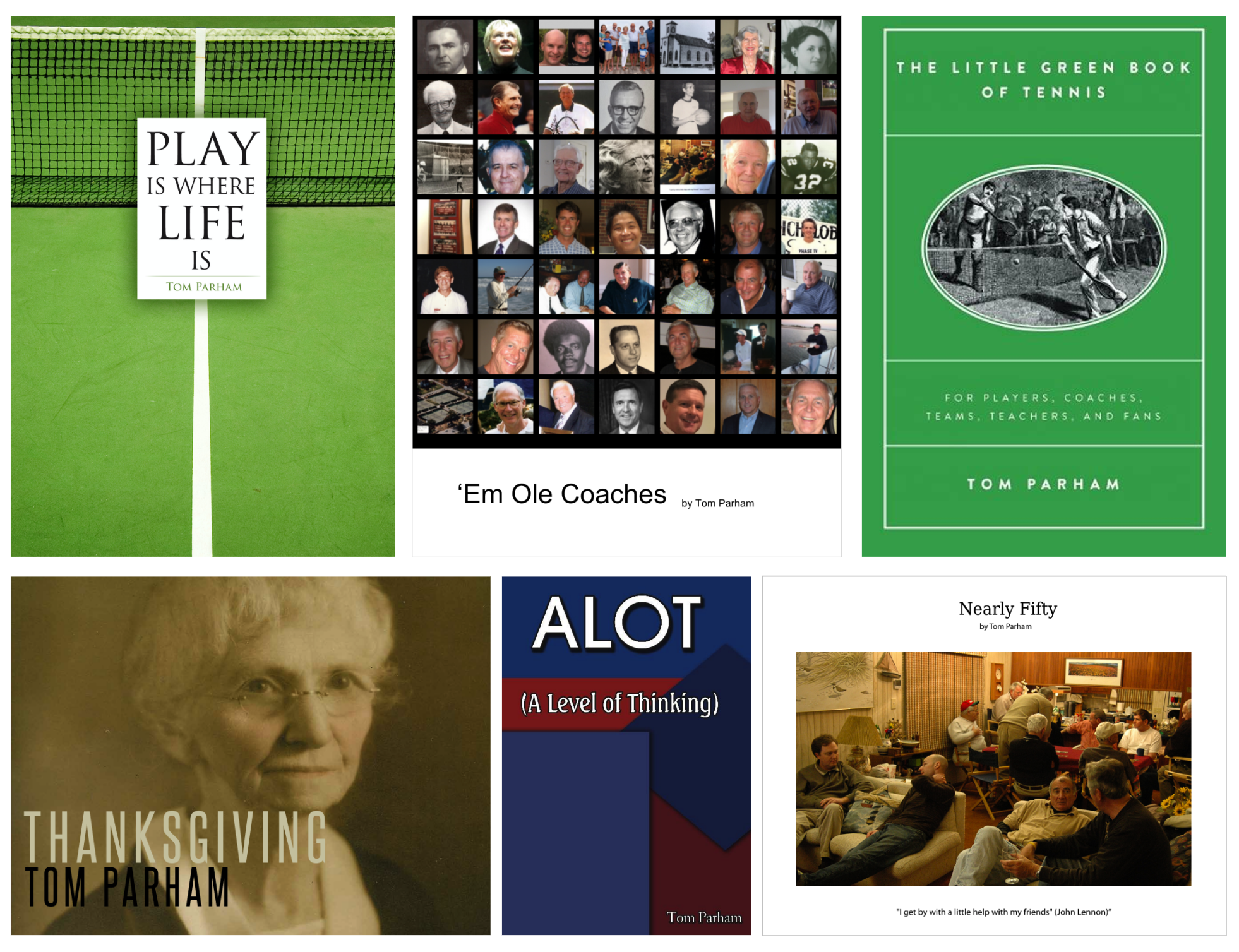
Image of all of Tom Parham's books

For anyone who is interested in my writing, here are links to free versions of all of my books. Just tap the book title to access a free PDF file on Google Drive.

Little Green Book of Tennis (3rd edition)
A new 2023 digital-only version of the Little Green Book edited to only tennis related writing, including some new chapters from the past few years. You can also download the3rd edition— a revised edition. Play is Where Life is is the first book I wrote.


Em Ole Coaches
Lessons learned from my family, friends, and colleagues over my career. This book is a personal collection of insights from some of my favorite people.


A Level of Thinking
A collection of essays on a wide variety of subjects including sports, politics, and American culture.


Helping
A collection of essays on tennis and coaching, many of which are posted here on the blog. The second half of the book chronicles the impact of international players on college tennis.


Thanksgiving
A collection of personal thoughts, stories, and pictures. Many of the essays were also posted here on my blog.


Nearly Fifty
For almost fifty years, my closest friends gathered once a year for a men’s weekend. This book collects some of my favorite stories and pictures from this tradition. If you would like a copy of this book, please email me.

JIM WHO? (21 )

From 1973 until 2000 the Governor of North Carolina’s first name was Jim ( HOLSHOUSER, HUNT, MARTIN, HUNT).

One of our football coaches laughingly told me of his eccentric Uncle. Uncle fashioned himself a powerful local politico. He dressed the part (pocket watch, cigar, authentic “harmuph” when speaking (loud, often and detached. ).

Coach said that his Uncle’s opening declaration was “… I was talking with Jim yesterday…”

If lucky,

some unsuspecting local would ask “Jim who”?

Jim Martin the Governor, you dumb son of a bitch! Harumph—the standard reply.

Three “JIMS ” were so helpful to my tennis experiences:

JIM LEIGHTON

JIM VERDIECK

JIM TONEY

JIM POWELL

Thanks, Jims

YOUR SPORT, YOUR SCHOOLS, YOUR KIDS (23)

America loves teams. And teamwork. My Father played team tennis for Wake Forest college in 1928. I played on any team that would give me a uniform. Both sons played high school and college team tennis. My grandson played #1 for Boulder High School as a freshman.

I am passionate about teams, and North Carolina. Later I will examine where this comes from. And how organizations, and “worker bees” and “tennis angels” can make things better.

There are great organizations alrready functioning. The North Carolina High School Athletics Association (NCHSAA ) sponsors the North Carolina High School Tennis Coaches (NCHSTCA). Later we will provide access to national groups.

A part of the United States Tennis Association (USTA), NCTA houses any number of tennis programs. From youngsters to seniors, to referees, to wheelchair competition. All worthy of support. One relatively new group has been the growth of league play. One could conclude the leagues growth was a savior, nationally and in our state as well. Coupled with Title IX and some altered attitudes , Women provided leadership , volunteering with impressive results.

While high scool tennis is only one of our causes, it is the one I feel most inclined to help. In 2015 we provided 700 boys and girls THE LITTLE GREEN BOOK OF TENNIS . Then we made it freely available to over 4,000 varsity boys and girls.

Due to turnover of all those players, plus more than half of the coaches, we offered the book again , with updated instruction in 2022. Here is your free link to edition three: https://docs.google.com/document/d/1IstkubA3qBwoJITAtqa2j1l5TW8hc2Myx_6_ZIwGqOs/edit#heading=h.s32ld9zdi0v0

One way to help!

VISION, PLANNING,AND GOALS for growing NC high school tennis teams, coaches, and players.

  1. To put together a non-profit group of our talented tennis people who embrace high school tennis in our state. Perhaps, like the league play leaders, they will function in perpetituity any number of ways to help the cause. The game changes. There is rapid turnover. The league players and coaches have the experience now to help coach, assist, advise referee, etc.
  2. As mentioned , there are already organizations in place and eager to help. We can make all this aid more accessible. Video selection, books, clinics. Some of the coaches are simply appointed, with NO tennis background. My experience is many are good people who do care about the kids. They need help ( see earlier articles) :

WAYS TO HELP—

HOW?

Much is already being done. The NCTA , The USTA, The NCHSAA, The North Carolina High School’s Coaches Association are going hard to help. Where help is needed comes from several sources:

**** Pay for these jobs is meager compared to what is asked and expected.
****The pay will not attract top notch tennis coaches in most instances. Most of the very good ones are volunteers, or close.
*** The typical “assigned” staffer is often a football coach, one who knows nothing about tennis. Or some similar scenario.
****More and more are “adjunct”, or part time coaches, who don’t have even the academic background that teacher/coaches have.

WHAT CAN HELP?
One way to start is a “THINK TANK” or committee to examine what is possible. We have a tremendous group of fine players throughout the state. We have in place an organization of teaching professionals in NC. Many times the best source is a “tennis angel” who silently plays with youngsters. No one gives more than parents. The club pro benefits from high school families.

There is another largely untapped source in our state. The NC TENNIS HALL OF FAME members. There seems to me to be a group of old pros and young turks in our select group who could also help the coaches in their area. Many of the hall of famers and pros are the same people. Many already give or have given to tennis in many ways. There are so many ways these people could enhance the knowledge, confidence, and performance of particularly the beginning coaches. I can’t list them all. Believe me, you can help.

I would also suggest to these coaches to look for the local angels. My experience is these are great people who only need to be asked. It may be one afternoon a week, It may be a helpful phone call. Showing a drill, filling in for an emergency, play an exhibition, take them to a college match, gift of equipment—old or new, simply attend matches, etc.

I think a good place to start “thinking” would be the coaches, the Pros, the angels ,and the organizations to brain storm the how. The why is obvious. And I think there is ample evidence that this help is available. And I am convinced the link between high school and juniors and parents and these volunteers can thrive.
The first place to start is knowledge plus need. Our hall of famers and our professional tennis teachers are where to start.

Some years back I watched a clinic foe NC high school coaches and concluded “…there is a lot more CARE in that group than knowledge. Granted several of the coaches demonstrated good skill on the court. I have said all along that a high school coach who cares and drives the van properly is all parents can hope for. Now I think it time to help them. They , by virtue of their attendance and willingness to coach our children, have earned our assistance.

COLLEGE, KIDS. QUESTIONS


Consider these:
1. Teaching Pros can be helpful to these high school coaches, players and teams. Very often the pros are much more knowledgeable and specialized in tennis.
High schoolers and younger are a great source for the pro’s business. A nurturing of this relationship is mutually beneficial.
2. High school sports are more and more selective. Basketball and football are sports not all are fitted for.  Youngsters  will look more and more for alternatives. More and more teams means more coaches are needed. In North Carolina more than half of the players are girls . Hasn’t the LEAGUE EXPERIENCE created a large group that now have the ability to help in any number of these programs?
Some stellar athletes might consider tennis because there is now a good coach.
3. Many won’t.
4. Why? Since the early 70’s more and more tennis scholarships have gone to internationals. We are in the third generation of this reality. The skyrocketing of college costs has paralleled the number of internationals.   And the number of grants for Americans have declined in a similar staggering proportion. Families invest tremendous amounts of money into their children’s tennis. It can be rewarded only two ways: 1.The extremely rare route of becoming a professional player and 2. College scholarships. And the scholarships grow more and more important annually.
5. One significant reason people are opting for sports other than tennis is that this third generation of parents and players have seen the scholarships  shipped  overseas.
6. This also manifests itself in the dearth of top pro players in America today. The obvious graph-like decline in quality of players in America coupled with the elimination of Americans selected for college scholarships should be grounds for new ideas.
7. Here is one. Is it not time to seriously study how to restore these opportunities and scholarships to our own?
8. Wouldn’t this benefit the hopeful high school or junior player in terms of motivation.

9.  Much has been written about internationals in American college. 

10. One last suggestion to high school coaches and tennis pros:  Coach–talented players are protective of their games and practices.  Work with the players and pros to allow meaningful practices, and still maintain team sacrifices.  Meet and set up a plan; the kid misses high school practice for pro lessons or a match with a high level opponent and yet gives back to  the team by helping less talented teammates.   Both interact in the long run.    PROS- encourage  why team play may teach more than individual success.  I wondered if  a “prima donna “wouldn’t play for his/her  high school , would they sacrifice as needed to be a good college teammate?

From Elie Wiesel:

“First I am a teacher.”

“If I am a witness (and your teacher ), you are a witness too.”

“Memory is the one thing that can save humanity.”

Student’s question : How do I help? Dr. Wiesel–“Start now! What do you see? What do you know?”

FINAL EDITION

The link at the bottom is to third edition of THE LITTLE GREEN BOOK of TENNIS. It is available to all, freely.

Several have asked why?

Upon retirement I asked my wife what’ s next ? ” I want to move to the beach!” Emerald Isle, NC for 17 years so far.

DIE BROKE by Stephen Pollan has four recommendations for retirees. Number 2 says DON’T RETIRE!: Meaning you should

have other meaningful plans.

In the off season at the beach you need that plan. Over time my plan evolved into “hobby writing”.

Motivation for this tennis book came several sources:

(Son, Dan Parham ) ” Dad–you know a lot about coaching tennis. You can put that stuff in the cloud, for everybody.

(Dr. Mildred Hartsock, late English Department Chair at alma mata , Atlantic Christian College .) ” You have some writing ability. You should major in English.”

( Jim Verdieck, late, great Redlands Tennis Coach). On my asking what happens to his tremendous knowledge? “When I die, it dies”. I told him I would try to prevent that.

(Jim Leighton, late, great Wake Forest Univesity Tennis Coach. ). Coach Leighton was the source of most of my knowledge of tennis. I took notes after our many sessions. He read a first draft of those attempts. “Tom, you have captured much of what we have covered. You can make a good book out of this, and if you do it will do more for tennis than all those National Championsships you have won.”

(Harvey Penick—THE LITTLE RED BOOK of GOLF author). “If you read this book you are my pupil. If you play golf you are my friend. “

( Jim Toney, late Economics Professor at Elon University and tennis angel )… A fine player and promoter of tennis, Mr. Toney and I zeroed in on High School tennis court construction. Later in his life he developed Parkinson’s. During our last conversation I told how much I appreciated the work he had done for tennis. He leaned forward, peering at me with those steely eyes, and said ” Don’t you quit.”)

https://docs.google.com/document/d/1IstkubA3qBwoJITAtqa2j1l5TW8hc2Myx_6_ZIwGqOs/edit?usp=sharing

(click link for the book )

Thinking ablout the last blog (FINAL EDITION ).

“FINAL EDITION ” REFLECTIONS

A Carolina (UNC CHAPEL HILL) football coach, commenting on my book THE LITTLE GREEN BOOK of TENNIS, suggested “…this is not just a tennis coaching aid, but for all coaches. ” High praise. I then realized I had mostly taken the methods of others, and the praise was theirs. What I also feel is these people showed us something even bigger than specialized coaching ; the whole process of teaching anything.

My Son, Dan, introduced the CLOUD’S possibilites.

Technology made my efforts possible. I hadn’t typed in fifty plus years. Never had cut a computer on. Wasn’t aware of self-publishing.

Looking back I am grateful there were so many good people and places to learn from. Looking forward I see many who could do similar sharing. So many have unique talent, backgrounds, and experience that could help others.

Information shared, data, truth.

PASSION

Recently I was described as “ passionate” about tennis.   A real compliment.   Immediately I thought of John Ormsby who wrote a  quite thorough history of Six Man Football in North Carolina.  I asked John where the drive to do this project came from?  He replied,  “…I wanted to know more about one subject  than anyone alive!”

Life without passion and drive is unappealing  to me.   Certainly our children deserve no less.   

One of my Sons made me aware of technology’s “cloud”.   “Dad, anyone can easily make special knowledge available to  all  now.”

Being a coach often makes you almost surrogate  fathers.  Certainly you care about your players.   My passion is care for American junior tennis players and their access to a fair share of our college and university tennis scholarships.   I believe there is a direct link between awarding  so many of our scholarships to internationals that we have run our own kids out of tennis, and other American sports as well.

Is this patriotic or xenophobic?   Is it illegal to reserve state tax money for our state’s youngsters.   Where is the fair “fine line” we can expect?

Passion number two:   The model for successful American juniors has been the  FAMILY not the ACADEMY model.  No ones cares like the parents.   Proper parental guidance,  local teaching pros,  community tennis “angels’,  junior tournaments, high school team play, and on to college tennis.  Examine our golden era of  pros  (Evert, Connors, McEnroes, Sampras, etc).